Big Names, Small Town Vibes: How National Companies Are Discovering Santa Maria's Secret Edge
The Word Is Getting Out
Santa Maria has always had a lot going for it. Ask anyone who's built a business here and they'll tell you about the mild climate, the tight-knit community, and a cost of doing business that makes the Bay Area and Los Angeles feel like a different planet. For years, though, that story mostly stayed local.
That's starting to change.
Over the past several years, a steady stream of established national companies has been quietly scouting — and in many cases, committing to — Santa Maria as a home for regional operations, distribution hubs, and back-office functions. It's not making front-page news in the Wall Street Journal, but if you're paying attention to commercial real estate activity, job postings, and city permit filings in the valley, the trend is hard to miss.
So what exactly is drawing them here? And what does it mean for the people and businesses already calling Santa Maria home?
Location, Location, Location — For Real This Time
You've heard the phrase a thousand times. But in Santa Maria's case, the geography genuinely delivers.
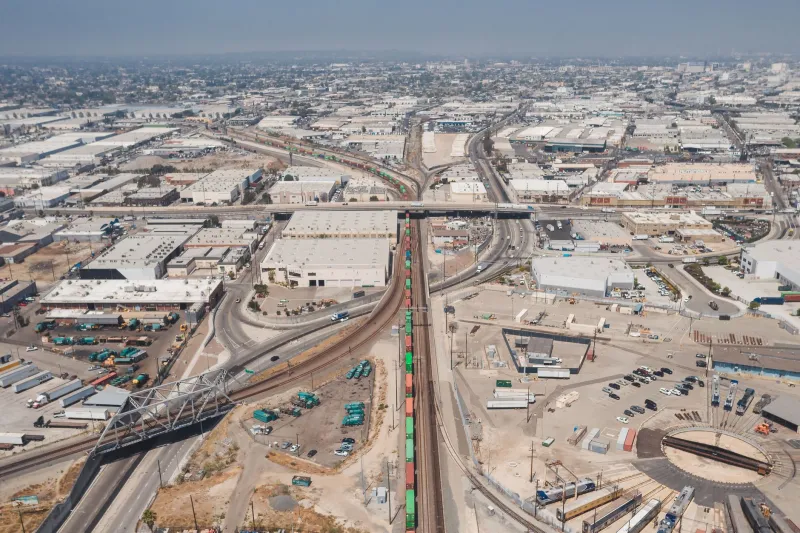
Sit down with a map and you'll see it immediately. Santa Maria sits almost exactly halfway between Los Angeles and San Francisco — two of the largest consumer markets in the country. U.S. Highway 101 runs right through town, and Union Pacific rail service adds another logistical layer that a lot of mid-sized California cities simply can't offer. For a company trying to move product up and down the West Coast, that kind of positioning isn't just convenient. It's a competitive advantage.
Add in the proximity to Santa Barbara and San Luis Obispo counties, and you've got a company that can reach millions of customers within a few hours of drive time — without paying Los Angeles real estate prices to do it.
The Real Estate Math Is Impossible to Ignore
Speak with any commercial broker working the Santa Maria market and they'll confirm what the numbers already show: industrial and warehouse space here is a fraction of what it costs in Southern California's Inland Empire, let alone the Bay Area. For companies that need square footage — distribution operations, light manufacturing, cold storage — that gap in cost can translate directly into margin.
The city and county have also made meaningful investments in infrastructure over the past decade, with industrial parks and shovel-ready sites that can accommodate larger footprints without the permitting nightmares that plague more congested urban markets.
For a regional VP staring down a spreadsheet and trying to justify a new facility to corporate, Santa Maria has a way of making the numbers look very, very good.
A Workforce That's Ready to Work
Here's the piece that doesn't always show up in the economic development brochures but matters enormously to companies once they're actually operating: the people.
Santa Maria's workforce is diverse, bilingual, and deeply experienced in industries that demand precision and reliability — agriculture, food processing, logistics, healthcare, and construction. The valley has a long tradition of hands-on work, and that culture carries over into the warehouse floor, the distribution dock, and the production line.
Allan Hancock College continues to be a significant asset in this regard, producing credentialed graduates in fields ranging from logistics and supply chain management to business administration and advanced manufacturing. Companies that have moved regional operations to the valley have noted, sometimes with genuine surprise, how quickly they're able to staff up with qualified candidates.
What It Means for Local Businesses
This is where the conversation gets a little more nuanced — and a little more interesting.
On one hand, national companies coming to town creates real opportunity for local businesses. More employees means more households with income to spend at Santa Maria restaurants, retailers, and service providers. Larger corporate tenants often actively seek local vendors for everything from janitorial services and landscaping to catering and marketing. A company that manages supply chains at a national scale still needs someone to fix the HVAC and stock the break room.
Smart local business owners are already positioning themselves to capture that spending. Building relationships early — before a national company is fully operational — can lock in contracts that provide steady, reliable revenue for years.
On the other hand, it would be naive to pretend there's no tension. National brands can apply competitive pressure on local counterparts in retail, food service, and professional services. They have marketing budgets and brand recognition that most homegrown businesses simply can't match dollar for dollar.
The local businesses that tend to thrive in this environment are the ones that lean hard into what they do best: personal relationships, community knowledge, and the kind of flexible, responsive service that a corporate playbook rarely delivers. That's not a small thing. It's actually a significant edge — if you use it.
The Cross-Pollination Nobody's Talking About
One of the more underappreciated dimensions of this trend is what happens when corporate operational experience meets local entrepreneurial energy.
When national companies set up in a community like Santa Maria, they bring with them managers and professionals who have seen how large-scale operations work — supply chain optimization, HR systems, technology infrastructure, quality control processes. Some of those people eventually decide they want to stay in the valley and put down roots. A few of them start businesses. Others take jobs at local companies and bring institutional knowledge with them.
That kind of cross-pollination — corporate know-how filtering into the local business ecosystem — can quietly raise the sophistication of the entire community over time. It's hard to quantify, but it's real.
The Santa Maria Valley Chamber of Commerce has a role to play here, too. Creating intentional spaces where national company representatives and local business owners can actually meet each other — not just in passing, but with purpose — accelerates that knowledge transfer and builds the relationships that turn a corporate tenant into a genuine community partner.
The Valley's Moment
Santa Maria has spent a long time being underestimated. Companies that bypassed the valley on their way to larger markets are now circling back — and in some cases, choosing it outright.
That's not an accident. It's the result of real assets: geography, affordability, workforce, and a community that knows how to get things done without a lot of drama.
The question for local businesses isn't whether national companies are coming. They already are. The question is whether the homegrown business community is ready to grow alongside them — capturing the opportunities, managing the competition, and making sure that the prosperity this moment creates stays rooted right here in the valley.